How to make the traction slide in your pitch deck
Based on advice from Aaron Harris (Y Combinator), Lenny Rachitsky, Rahul Vohra (Superhuman) · Updated 2 October 2026
Short answer
Show your traction if you have it, and make the numbers clear and meaningful, with context next to the chart. That's Y Combinator's guidance for the traction slide, which comes right after the solution in its seed template. Revenue beats other metrics when you have it, and your curve doesn't need to be smooth.
What YC asks for
- Show traction if you have it, early in the deck: right after the solution.
- Make the numbers clear and meaningful.
- Add context next to the chart when you have great stats to support it.
- If you have more metrics, add them on the next slide.
- Revenue is better than other metrics when you have it.
- It's unlikely your curve will be smooth. That's fine.
How to tell if your numbers are good
- Retention: Lenny Rachitsky's benchmarks say around 40% of users still active after 6 months is good for consumer SaaS, and around 60% for SMB SaaS.
- Product-market fit: Superhuman's survey asks users how they'd feel if they could no longer use the product. If 40% or more say "very disappointed", you're likely there.
In your deck
Read your traction slide's headline alone. If it says "Traction" instead of what the numbers prove, rewrite it.
Real examples
YouTube (2005) · slide 10
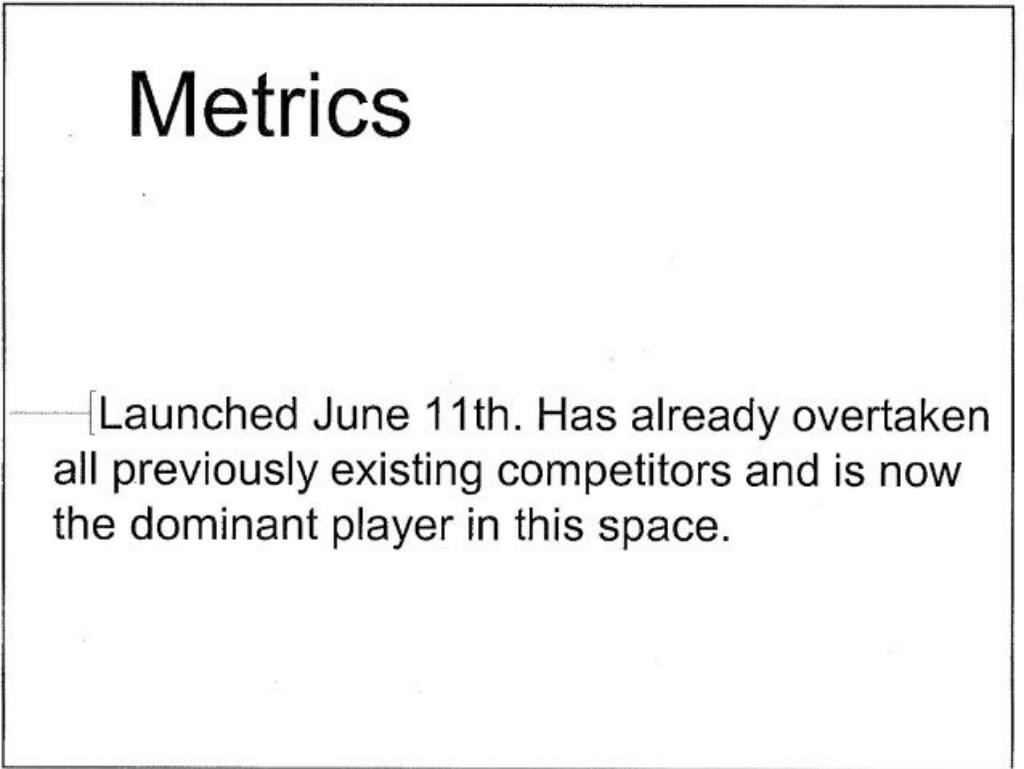
The widely shared version of YouTube's 2005 deck ends on metrics: launched in June, and already ahead of every competitor. Plain black text on white.
See the whole YouTube deck
Coinbase (2012) · slide 4
Coinbase's seed deck shows a rising chart of bitcoin volume and one number: $2 million a day.
See the whole Coinbase deck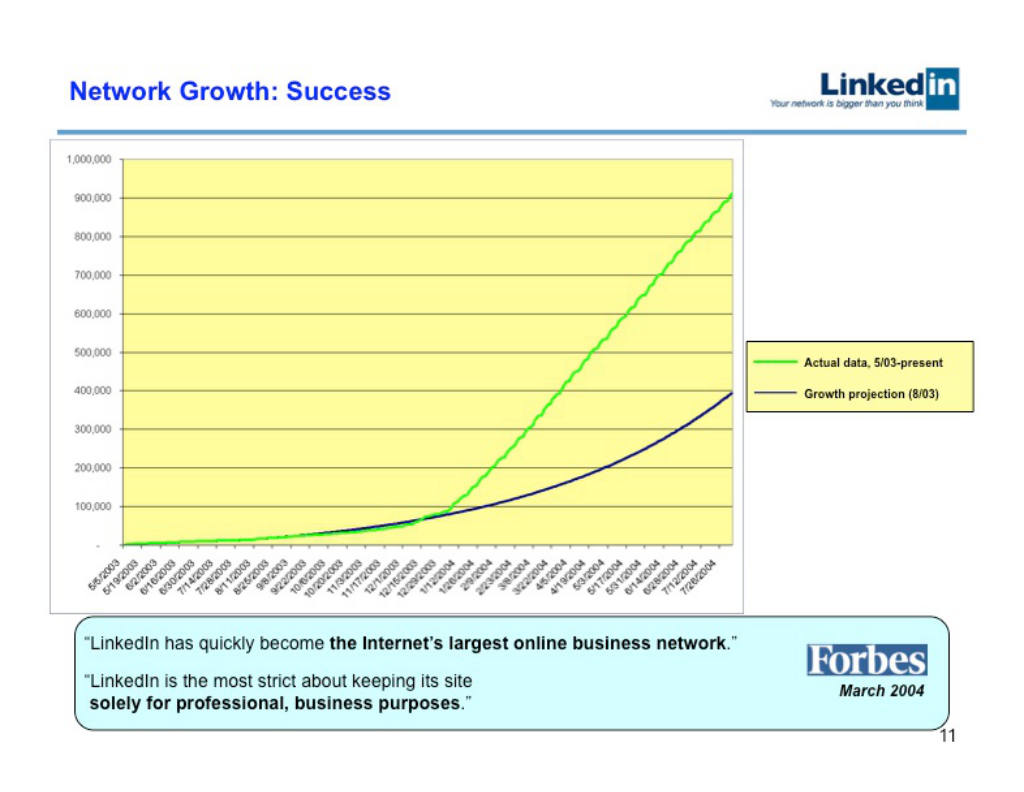
LinkedIn (2004) · slide 11
LinkedIn compared actual users with its own plan: more than 900,000, over double the projection.
See the whole LinkedIn deck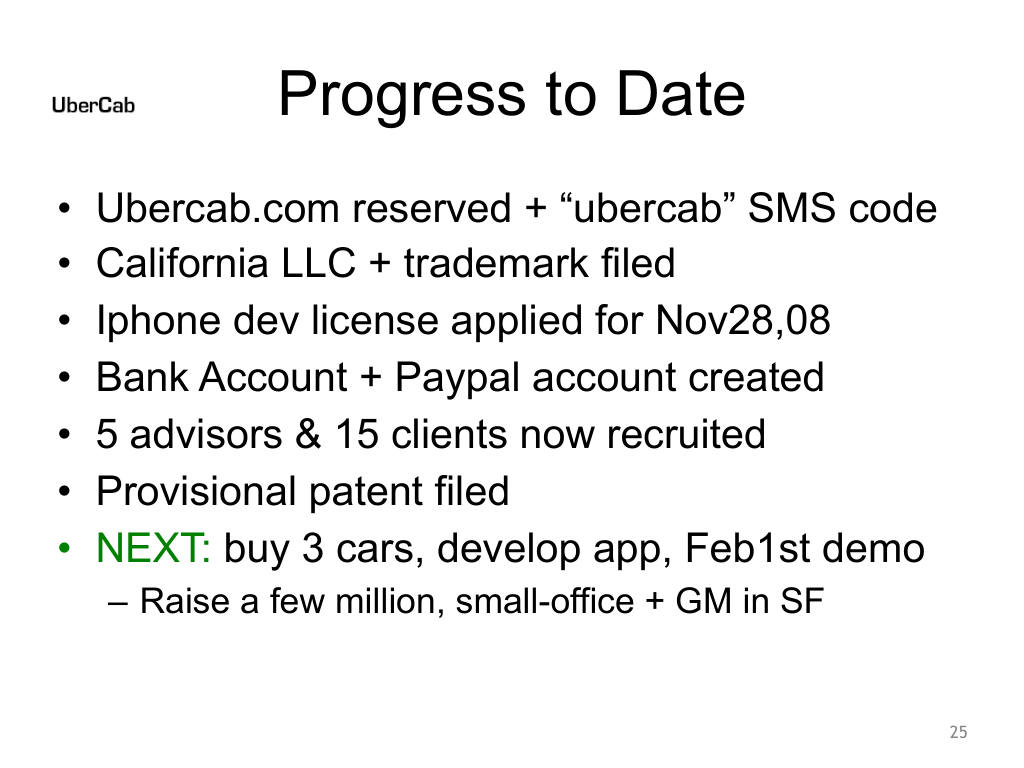
Uber (2008) · slide 25
With no product yet, Uber's seed deck listed concrete progress instead: the domain, the company and trademark filed, 5 advisors and 15 clients, and dated next steps.
See the whole Uber deck
Read the originals
- How to build your seed round pitch deck · Aaron Harris (Y Combinator)
YC's guidance for the traction and metrics slides.
- What is good retention · Lenny Rachitsky
Benchmarks to know whether your retention is good or great.
- Cohort analysis template · Christoph Janz (Point Nine)
Show retention as cohorts, the way investors read it.
Questions founders ask
- Where does the traction slide go in a pitch deck?
- In Y Combinator's seed template it comes right after the solution, before the insight, business model, market and team.
- What if I don't have traction yet?
- YC's template says to show traction if you have it. Without it, early decks like Uber's 2008 seed deck showed concrete progress instead: what's been done and the dated next steps.
- Is revenue better than user numbers on a traction slide?
- Yes, when you have it. YC's seed template notes that revenue would be better than other metrics.
Get your deck reviewed the same way.
Comments on every slide, the words to change highlighted, and the 3 fixes that matter.
Keep reading
- What is good retention? Benchmarks by product type
Good and great retention benchmarks from Lenny Rachitsky: 6-month user retention and 12-month net revenue retention for consumer, SMB and enterprise products.
- How to know if you have product-market fit
Marc Andreessen's definition of product-market fit, and the 40% survey Superhuman used to measure it: the questions, the threshold and how to raise your score.
- How to build a seed pitch deck: YC's template, slide by slide
Y Combinator's seed deck template explained slide by slide: title, problem, solution, traction, insight, business model, market, team and the ask.
- How many slides should a pitch deck have?
Y Combinator's seed template points to 10 to 15 slides. What famous decks like Airbnb, Coinbase, Intercom and Uber actually used.