
How to write the problem slide in your pitch deck
Based on advice from Aaron Harris (Y Combinator), Kevin Hale (Y Combinator) · Updated 2 October 2026
Short answer
State the problem clearly and show how it affects real people or businesses, which is how Y Combinator's seed template puts it. The strongest problems, in YC partner Kevin Hale's words, are popular, growing, urgent, expensive, mandatory or frequent. You don't need all six, but the more you can show, the better.
What makes a problem worth funding
Kevin Hale's six signs of a good problem, from YC's Startup School:
- Popular: a lot of people have it.
- Growing: more people run into it every year.
- Urgent: they need it solved now.
- Expensive: it costs real money, so they'll pay to fix it.
- Mandatory: they have to solve it, often because of a rule or a change they can't avoid.
- Frequent: it comes back again and again.
How it shows on the slide
- YC asks for the particulars: how the problem affects real people or businesses.
- The problem comes before the solution in YC's template, so the investor feels it first.
- If your problem has several of Kevin Hale's six signs, make each one visible, ideally with a number.
In your deck
Check which of the six signs your problem slide actually shows, and which it only assumes.
Real examples
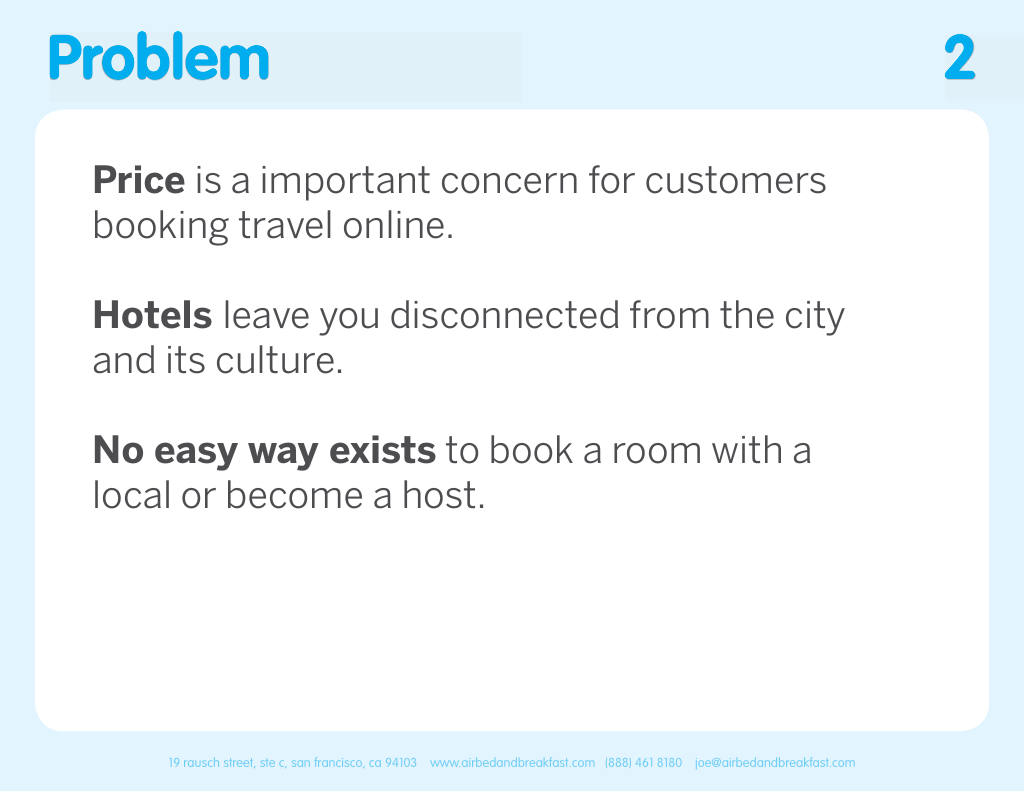
Airbnb (2008) · slide 2
Airbnb named three problems in three short sentences: price matters to travelers, hotels cut you off from the city, and there's no easy way to book a room with a local.
See the whole Airbnb deck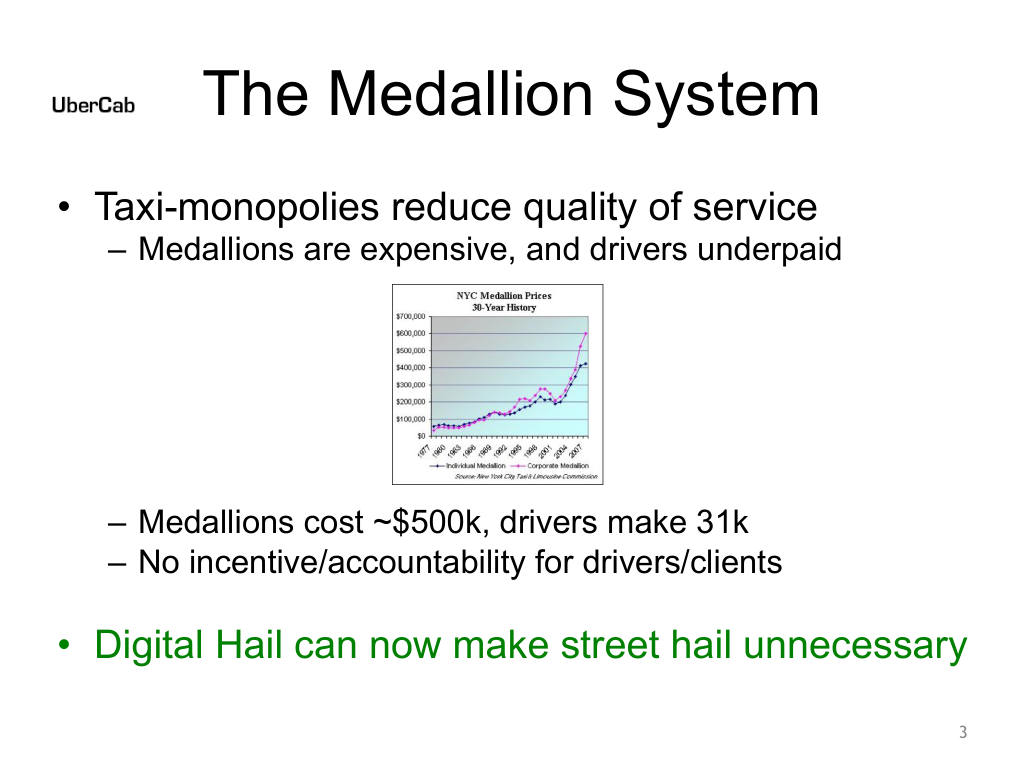
Uber (2008) · slide 3
Uber made the problem concrete with numbers: taxi medallions cost about $500K while drivers make $31K.
See the whole Uber deck
Read the originals
- How to build your seed round pitch deck · Aaron Harris (Y Combinator)
Where the problem slide sits in the seed deck and what YC wants on it.
- How to evaluate startup ideas · Kevin Hale (Y Combinator)
The Startup School talk with the six signs of a good problem.
Questions founders ask
- What goes on a pitch deck problem slide?
- A clear statement of the problem and how it affects real people or businesses, as Y Combinator's seed template puts it.
- Should the problem slide come before the solution?
- Yes. In Y Combinator's seed template the problem comes right after the title, before the solution.
- What makes a good problem for a startup?
- YC partner Kevin Hale lists six signs: popular, growing, urgent, expensive, mandatory and frequent. You don't need all six, but the more the better.
Get your deck reviewed the same way.
Comments on every slide, the words to change highlighted, and the 3 fixes that matter.
Keep reading
- How to build a seed pitch deck: YC's template, slide by slide
Y Combinator's seed deck template explained slide by slide: title, problem, solution, traction, insight, business model, market, team and the ask.
- How to make the traction slide in your pitch deck
What YC says goes on a pitch deck traction slide, with real examples from YouTube, Coinbase, LinkedIn and Uber, and benchmarks for good retention.
- How many slides should a pitch deck have?
Y Combinator's seed template points to 10 to 15 slides. What famous decks like Airbnb, Coinbase, Intercom and Uber actually used.
- How to make the title slide of your pitch deck
What goes on a pitch deck title slide, per Y Combinator: your name and one line on what you do. Plus Kevin Hale's test for any slide, with real examples.