
How to build a seed pitch deck: YC's template, slide by slide
Based on advice from Aaron Harris (Y Combinator), Kevin Hale (Y Combinator) · Updated 2 October 2026
Short answer
Follow Y Combinator's seed deck template: a title slide, then problem, solution, traction, insight, business model, market, team and the ask. Aaron Harris, who wrote it, says to aim for one slide per section and never more than three, and to strive for clarity and concision, because most seed companies don't have much meaningful detail to explore yet.
The slides, in YC's order
- Title. Your company name and one line on what you do. This is the only section that should be exactly one slide.
- Problem. State it clearly, with the particulars of how it affects real people or businesses.
- Solution. Explain what you do in as few words as possible, and the concrete benefits.
- Traction. Show it if you have it, with numbers that are clear and meaningful. Add context next to the chart. If you have more metrics, add them.
- Insight. What makes you special and why this works. This can take more than one slide.
- Business model. You won't know every detail yet, but you should know a lot of them. Lay it out.
- Market. Is it big, will you make it big, and how much money can this make? Convince the investor they'll make a lot of money with you.
- Team. Very important at seed. Why your founders are particularly suited to this problem. It's about the founders, not advisors.
- The ask. How much you're raising and what it gets you. If you can show where you'll be in a year, ready for a Series A, that's powerful.
The rules behind the template
Harris sums it up in one line: "Focus on narrative. The rest is commentary."
- Clarity and concision come first. A seed deck is not the place for a treatise on your market.
- Treat each section as a set of slides. One is ideal, more is fine, and you probably never want more than three.
- Keep the design simple. YC's Kevin Hale wrote the companion guide on making slides legible, simple and obvious.
- The same structure works for a Series A deck, with more evidence behind each section.
In your deck
Read your deck's headlines in order and check they match these sections. If a section is missing, or takes more than three slides, that's where to start.
Real examples
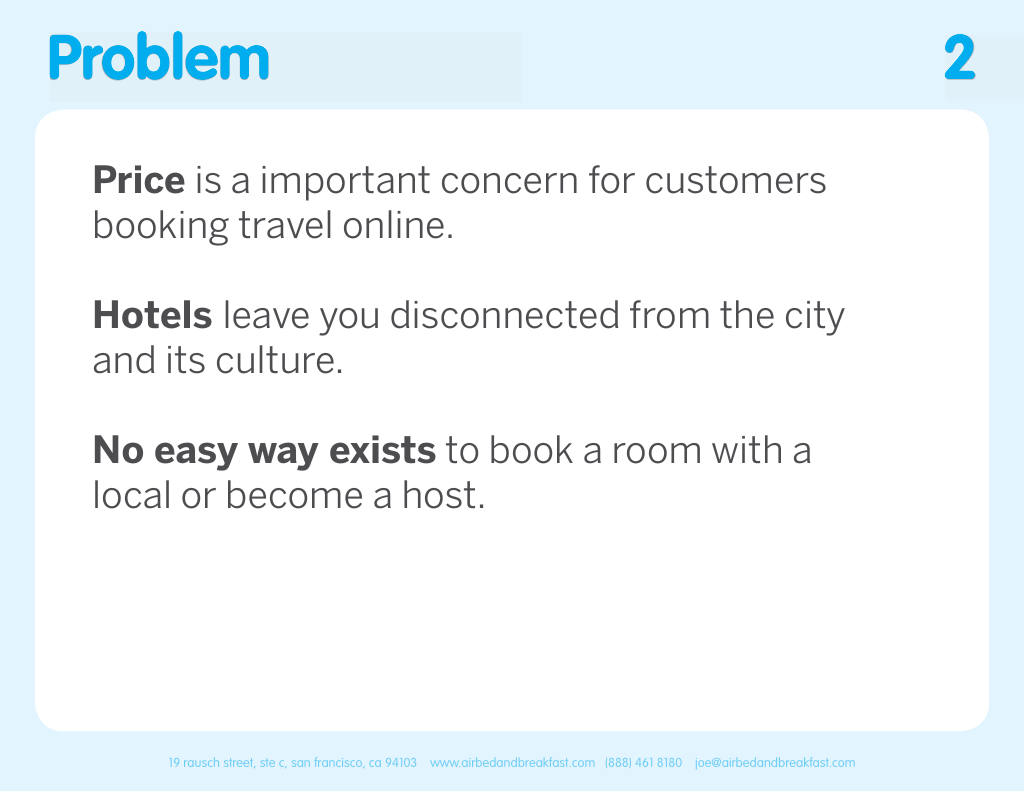
Airbnb (2008) · slide 2
Airbnb's 2008 seed deck follows almost the same order a decade before YC wrote it down: problem, solution, validation, market, product, business model and the ask, in 14 slides.
See the whole Airbnb deck
Coinbase (2012) · slide 4
Coinbase's 2012 seed deck covers the whole story in 11 slides, with its growth charts doing most of the work.
See the whole Coinbase deck
Read the originals
- How to build your seed round pitch deck · Aaron Harris (Y Combinator)
The original template with every slide. Copy it and fill it in.
- How to design a better pitch deck · Kevin Hale (Y Combinator)
The companion guide on making each slide legible, simple and obvious.
- Writing a business plan · Sequoia Capital
Sequoia's outline, useful to check you haven't missed a part of the story.
Questions founders ask
- What slides should a seed pitch deck have?
- Following Y Combinator's template: title, problem, solution, traction, insight, business model, market, team and the ask.
- Is the YC seed deck template the same as a Series A deck?
- Mostly. Aaron Harris says the seed template is not all that different from best practice for a Series A deck. The difference is the evidence: at Series A each section needs real metrics behind it.
- Where can I get the YC seed deck template?
- It's free in Y Combinator's Startup Library, in Aaron Harris's post "How to build your seed round pitch deck".
Get your deck reviewed the same way.
Comments on every slide, the words to change highlighted, and the 3 fixes that matter.
Keep reading
- How many slides should a pitch deck have?
Y Combinator's seed template points to 10 to 15 slides. What famous decks like Airbnb, Coinbase, Intercom and Uber actually used.
- How to write the problem slide in your pitch deck
What YC says goes on a pitch deck problem slide, Kevin Hale's six signs of a great problem, and how Airbnb and Uber framed theirs.
- How to make the traction slide in your pitch deck
What YC says goes on a pitch deck traction slide, with real examples from YouTube, Coinbase, LinkedIn and Uber, and benchmarks for good retention.
- How to make the title slide of your pitch deck
What goes on a pitch deck title slide, per Y Combinator: your name and one line on what you do. Plus Kevin Hale's test for any slide, with real examples.