
Traction quality: why depth in one market beats breadth
An idea from Bill Gurley (Benchmark), Brett Bivens (Venture Desktop) · Updated 2 October 2026
More from Bill Gurley and Benchmark
Short answer
Bill Gurley of Benchmark calls it liquidity quality: passionate users, high frequency and a great experience, even in one small area. He cares far more about it than about how broad you are. Great unit economics and growth in a single city, with a playbook that's clearly working, show network effects, and venture money can buy breadth later.
What high liquidity quality looks like
- Users are passionate about the product.
- They use it often.
- The experience is great, even if it only works in a small area.
- Unit economics and growth are strong where you operate, and getting better.
What Gurley warns against
Founders who think they need to expand to ten cities quickly to raise their Series A or B. In his words: "I care way more about liquidity quality than I do how broad you are." If the fire is burning bright in one place, venture dollars and growth playbooks can take it wide.
Examples
- Yelp: Jeremy Stoppelman did things that don't scale at nightclubs in San Francisco, and people wrote passionate reviews, often.
- Uber: as Brett Bivens describes, it started with black cars in San Francisco, then UberX, then UberPool, each step built on depth it had already proven.
In your deck
On your traction slide, show depth before breadth: how often people use it, how many come back, and your unit economics in your core market. One market that works beats a map of cities that don't yet.
Real examples
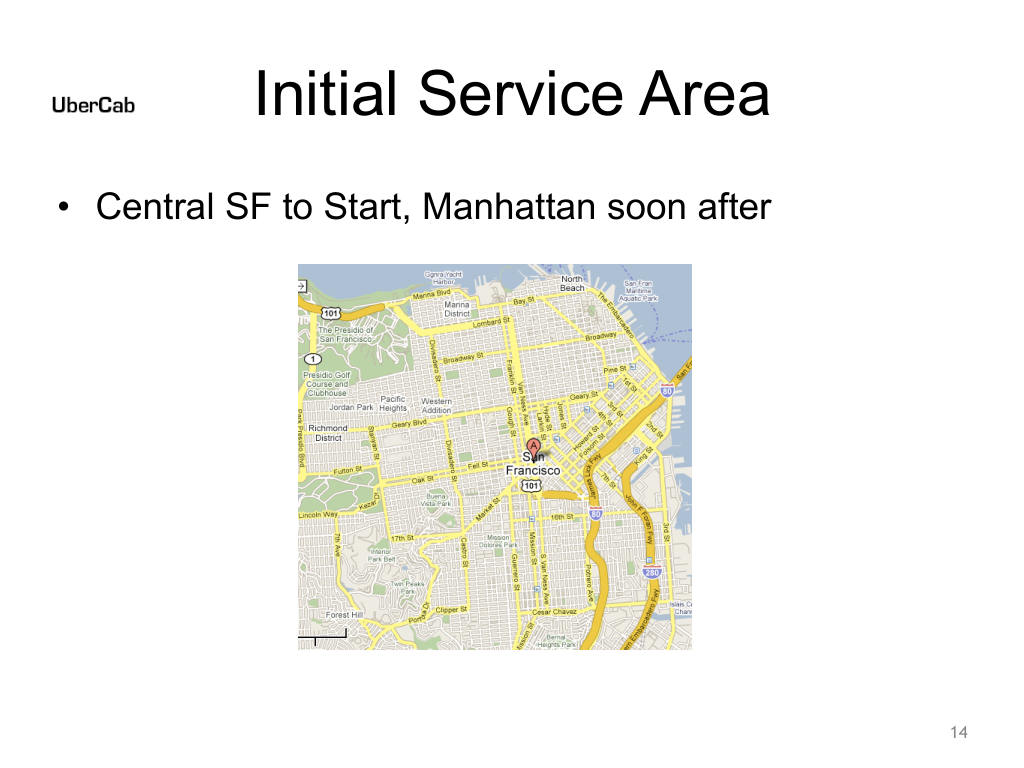
Uber (2008) · slide 14
Uber's 2008 seed deck started with a map of central San Francisco, with Manhattan to follow.
See the whole Uber deck
Read the originals
- Bill Gurley on liquidity quality · Bill Gurley (Invest Like the Best, 2019)
Gurley's own words on why depth in one market beats breadth.
- The merits of bottoms-up investing · Brett Bivens (Venture Desktop)
Gurley's liquidity quality in context, with Yelp and Uber as examples.
- What is good retention · Lenny Rachitsky
Benchmarks to check how often people come back.
Questions founders ask
- What is liquidity quality?
- Bill Gurley's term for how strong a marketplace is where it operates: passionate users, high frequency and a great experience, even in a small area.
- Should I expand to more cities before raising my Series A?
- Not necessarily. Gurley cares more about great unit economics and growth in one city, with a working playbook, than about how many cities you're in.
- What is traction quality?
- How strong your traction is, not just how big: how passionate and frequent your users are and how good your unit economics are where you operate.
Get your deck reviewed the same way.
Comments on every slide, the words to change highlighted, and the 3 fixes that matter.
Keep reading
- How to make the traction slide in your pitch deck
What goes on a pitch deck traction slide, with real examples from YouTube, Coinbase, LinkedIn and Uber, and benchmarks for good retention.
- What is good retention? Benchmarks by product type
Good and great retention benchmarks from Lenny Rachitsky: 6-month user retention and 12-month net revenue retention for consumer, SMB and enterprise products.
- How to know if you have product-market fit
Marc Andreessen's definition of product-market fit, and the 40% survey Superhuman used to measure it: the questions, the threshold and how to raise it.