
Kalshi pitch deck (2020)
Kalshi's 2020 pitch deck is the 18-slide Series A deck Tarek Mansour and Luana Lopes Lara used to pitch Sequoia, which led Kalshi's $30M Series A in February 2021. Sequoia's Alfred Lin published the full deck in November 2026, with the founders' permission, the week Kalshi raised $1B at a $40B valuation. Founders study the Kalshi pitch deck because it sells a company before launch on two things: a regulatory moat that took years to build, and a plan for creating liquidity in a market that did not exist yet.
- Company
- Kalshi
- Year
- 2020
- Round
- Series A
- Raised
- $30M
- Slides
- 18
Deck © Kalshi. Shared for learning, credited to x.com.
What's in the Kalshi pitch deck
All 18 slides, in order.
Slide 1 · Cover
The Kalshi name, the green K logo and one line, trade on event outcomes.
How to write this slide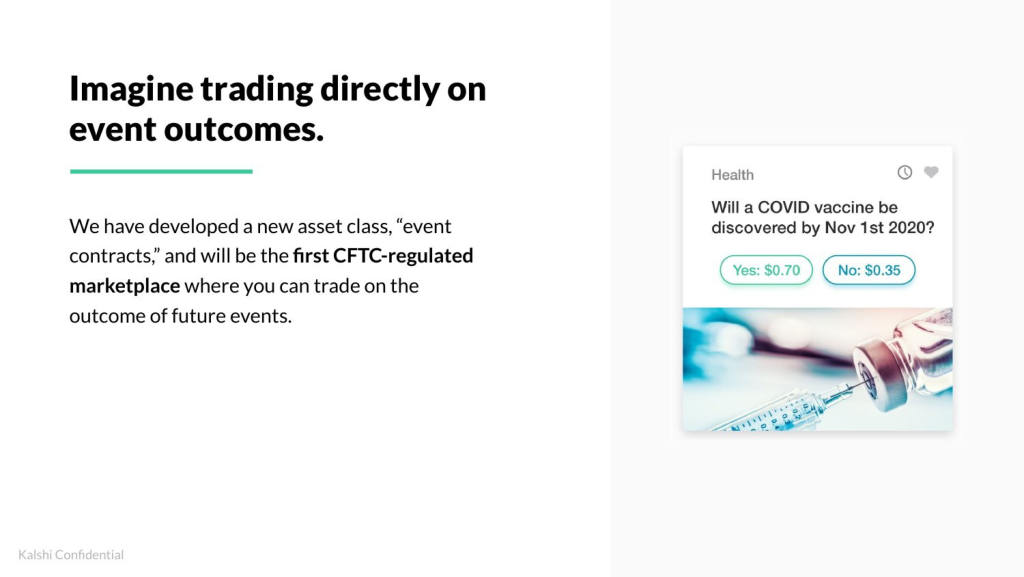
Slide 2 · Solution: trading on event outcomes
Imagine trading directly on event outcomes. Kalshi has built a new asset class, event contracts, and will be the first CFTC-regulated marketplace for them, shown with a sample contract asking whether a COVID vaccine will be discovered by 1 November 2020, priced Yes $0.70 and No $0.35.
How to write this slide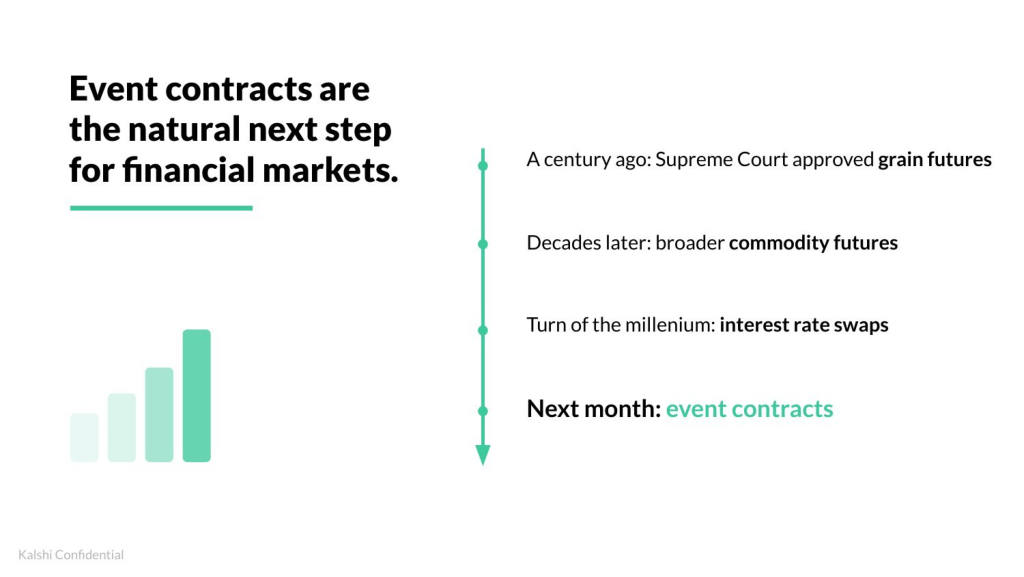
Slide 3 · Why now: the next step after futures and swaps
A timeline from grain futures a century ago, to commodity futures, to interest rate swaps at the turn of the millennium, ending with next month, event contracts.
How to write this slide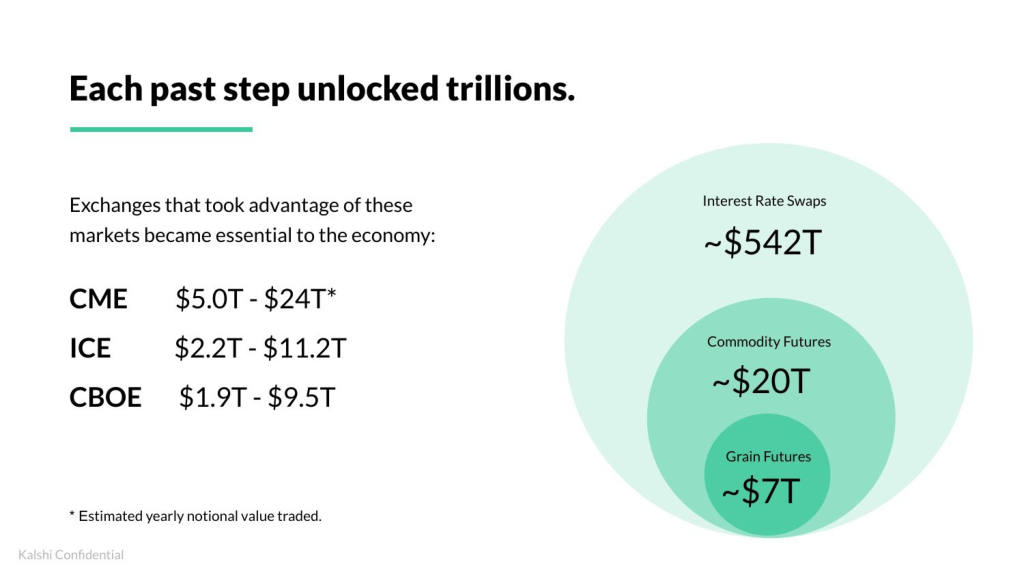
Slide 4 · Market size: each past step unlocked trillions
Nested circles for grain futures (about $7T), commodity futures (about $20T) and interest rate swaps (about $542T), next to the yearly notional value traded on CME, ICE and CBOE.
How to write this slide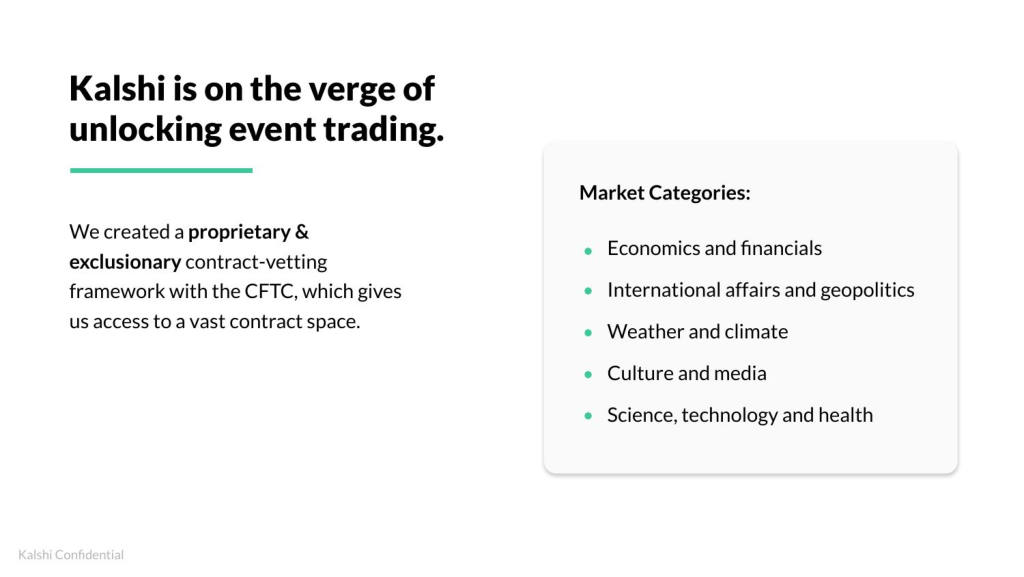
Slide 5 · On the verge of unlocking event trading
A contract-vetting framework built with the CFTC gives Kalshi access to a vast contract space, across five categories from economics and geopolitics to weather, culture and science.
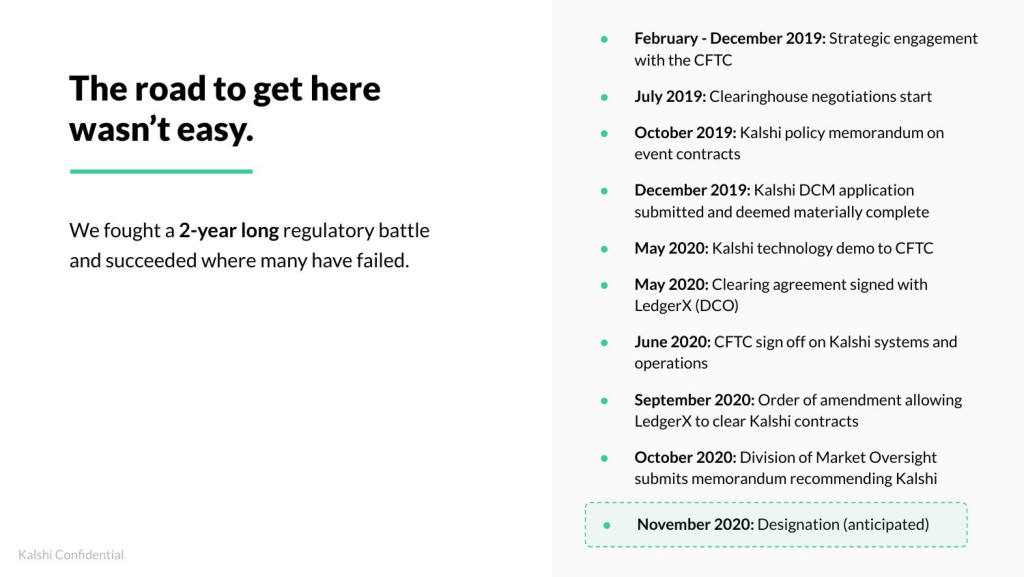
Slide 6 · Progress: the road to get here
A 2-year regulatory fight, laid out month by month from February 2019 to a CFTC designation anticipated in November 2020, including the clearing agreement with LedgerX.
How to write this slide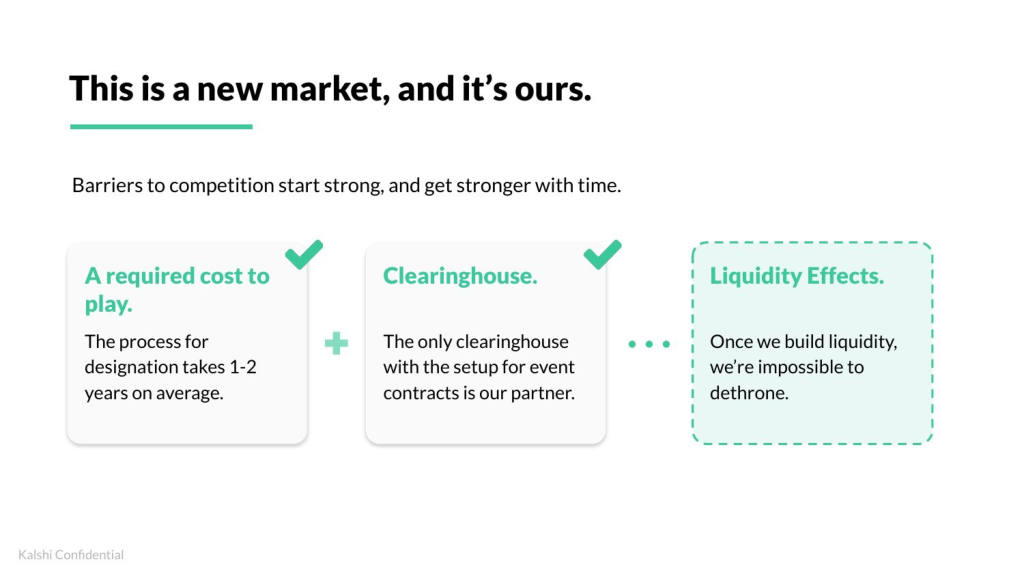
Slide 7 · Competitive advantage: barriers that grow
Barriers that get stronger with time: designation takes 1 to 2 years, the only clearinghouse set up for event contracts is Kalshi's partner, and once liquidity is built Kalshi is impossible to dethrone.
How to write this slide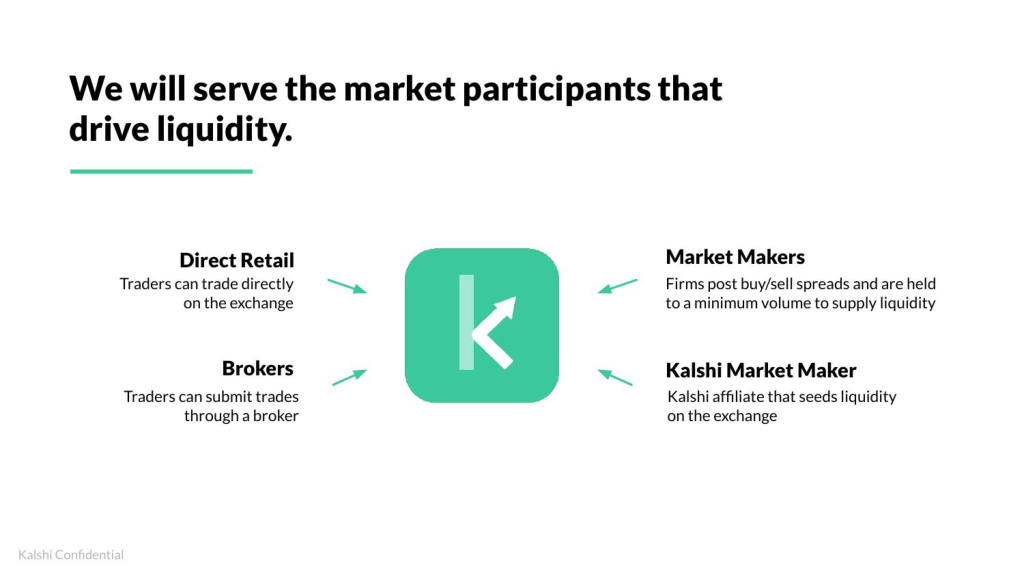
Slide 8 · Who brings liquidity
Four sources of orders around the exchange: direct retail traders, brokers, outside market makers and Kalshi's own affiliate market maker.
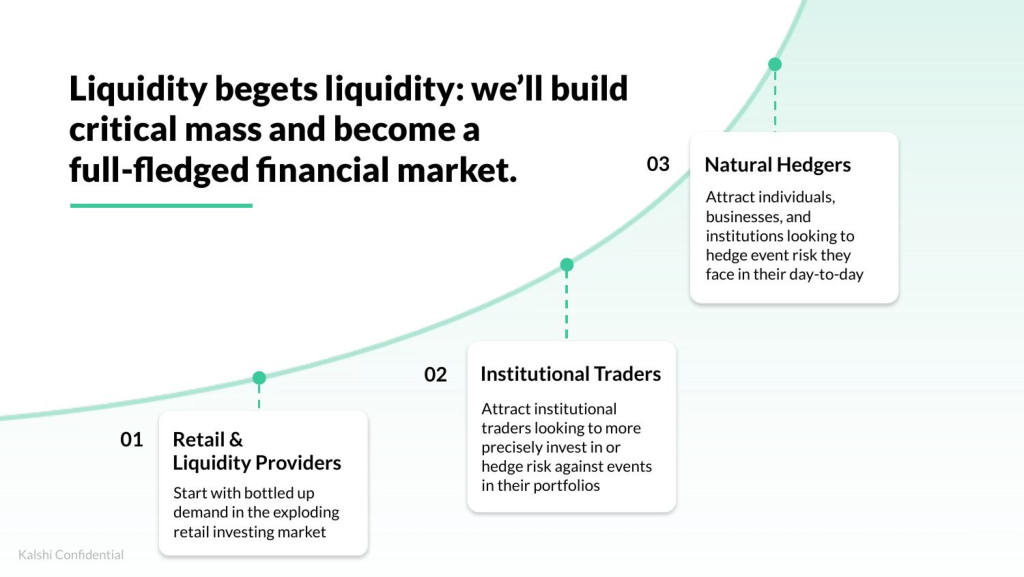
Slide 9 · Liquidity plan: retail first, then institutions
Three stages on a rising curve, retail traders and liquidity providers first, then institutional traders, then natural hedgers such as businesses facing event risk.
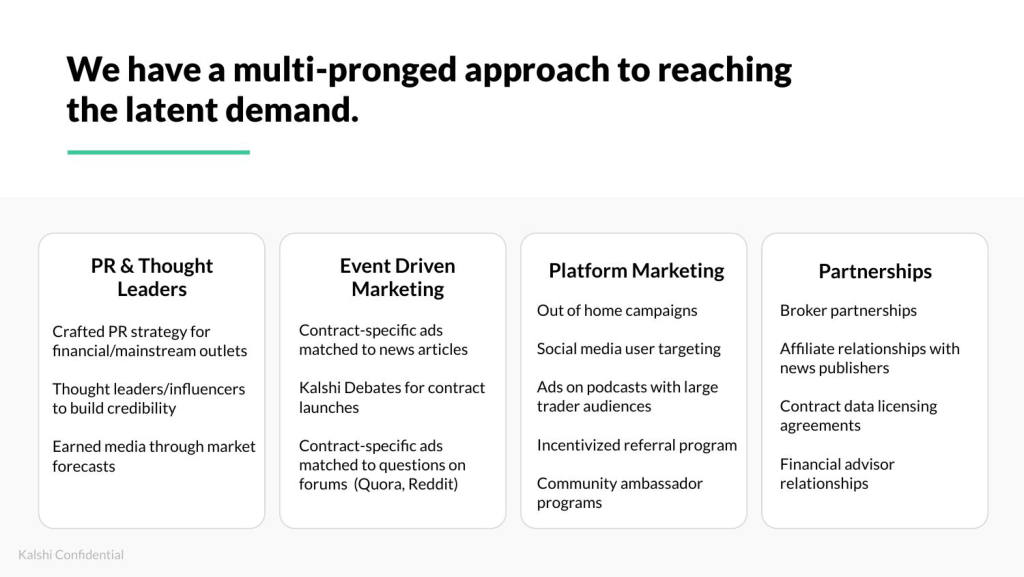
Slide 10 · Acquisition channels
Four columns of ways to reach latent demand: PR and thought leaders, event-driven ads matched to news articles and forum questions, platform marketing with a referral program, and partnerships with brokers and news publishers.
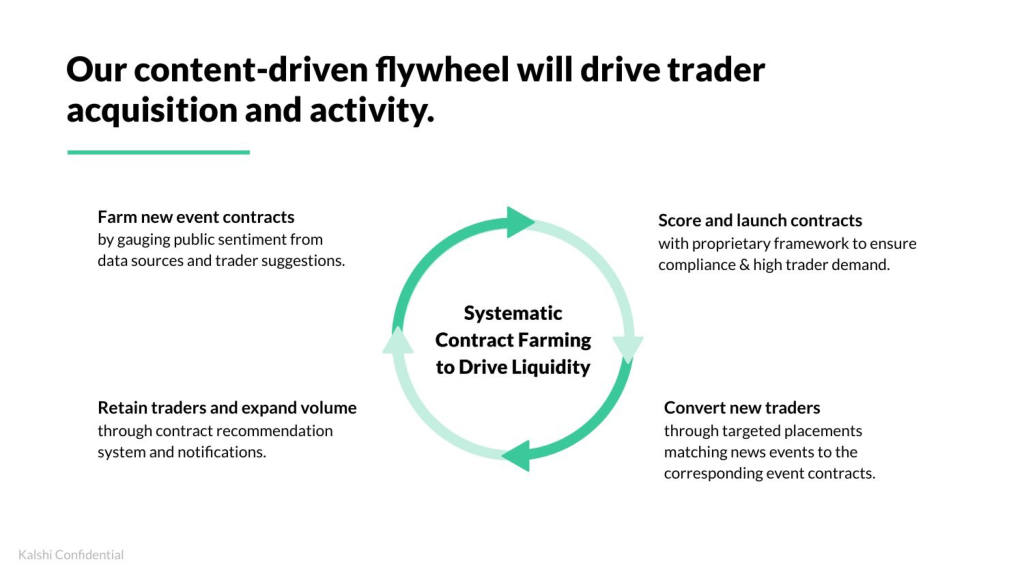
Slide 11 · Contract-farming flywheel
Systematic contract farming: find new contracts from public sentiment, score and launch them, convert traders with ads matched to news, and retain them with recommendations and notifications.
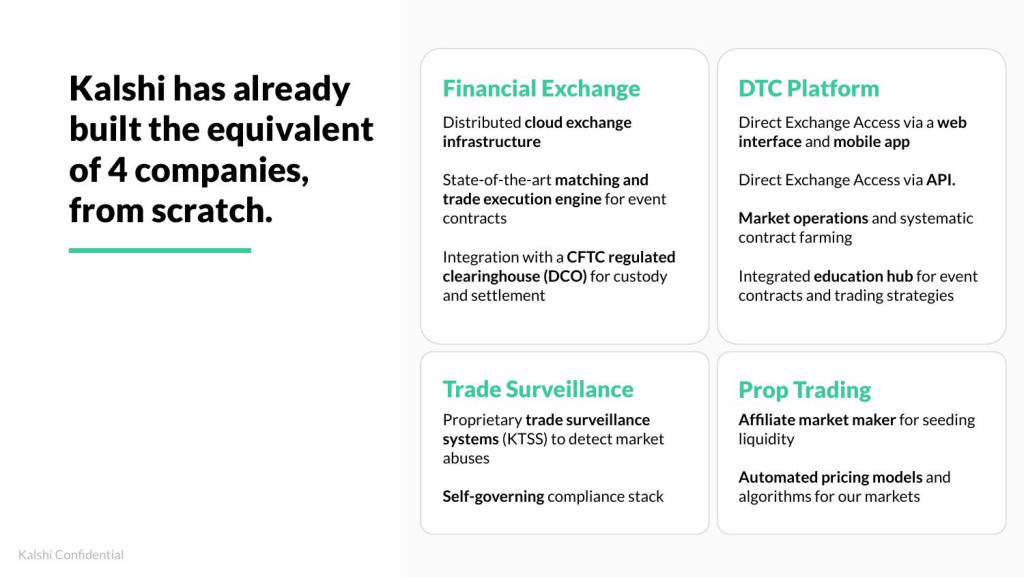
Slide 12 · What's built: 4 companies from scratch
A financial exchange, a direct-to-consumer web and mobile platform with an API, a trade surveillance system and an affiliate prop trading desk.
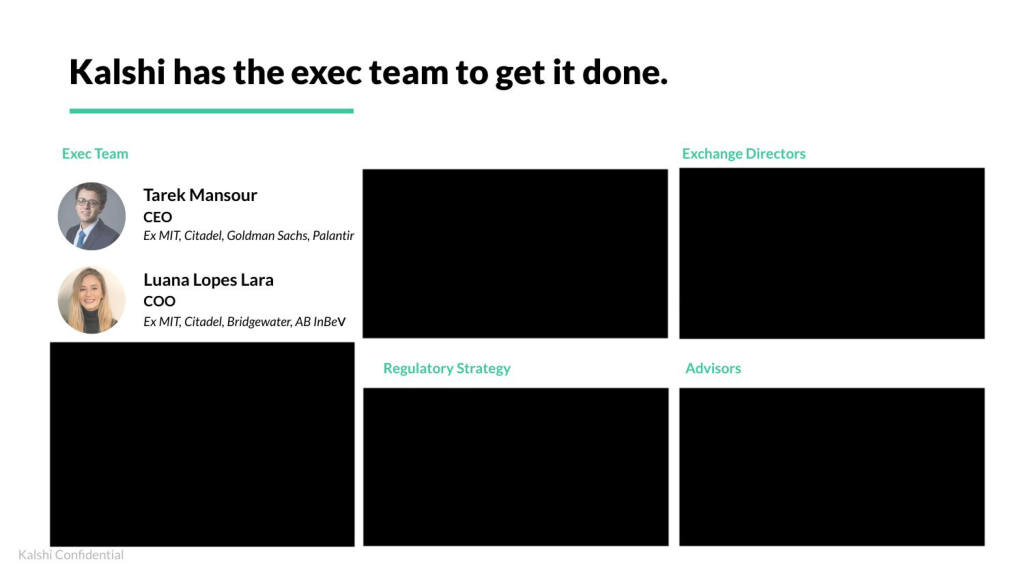
Slide 13 · Exec team
Tarek Mansour (CEO, ex MIT, Citadel, Goldman Sachs, Palantir) and Luana Lopes Lara (COO, ex MIT, Citadel, Bridgewater, AB InBev). The exchange directors, regulatory strategy and advisor panels are blacked out in the published version.
How to write this slide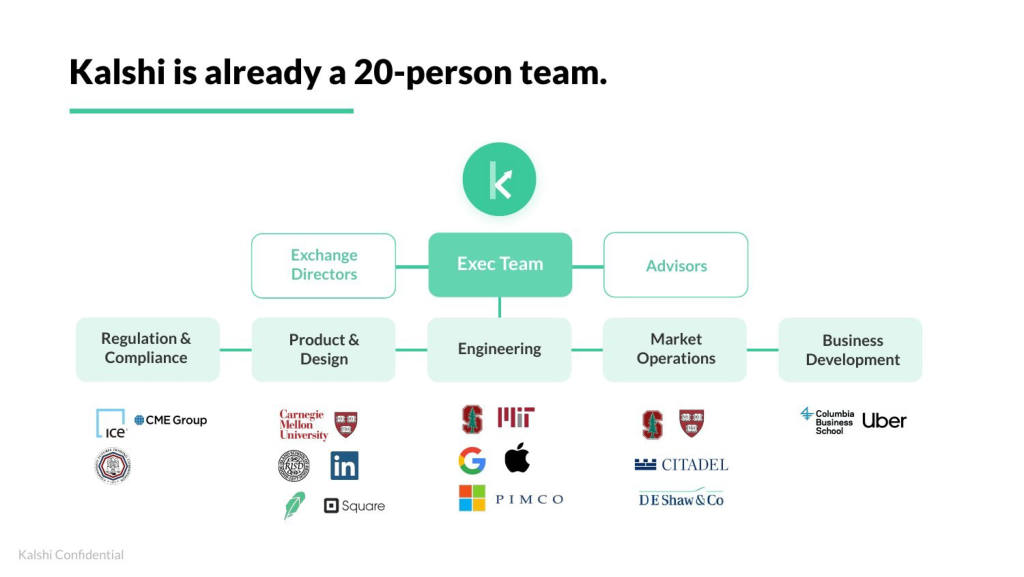
Slide 14 · Team: already 20 people
An org chart from exec team down to regulation, product, engineering, market operations and business development, with logos of where people came from, such as CME Group, Google, Citadel and Uber.
How to write this slide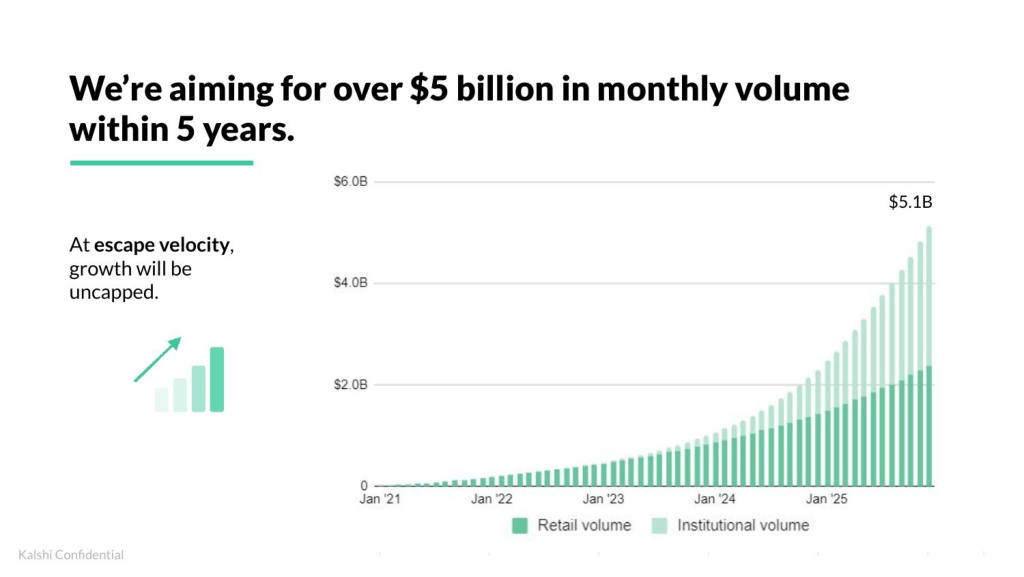
Slide 15 · Projections: $5B in monthly volume
Monthly volume from January 2021 rising to $5.1B within 5 years, split into retail and institutional, with the line that at escape velocity growth will be uncapped.
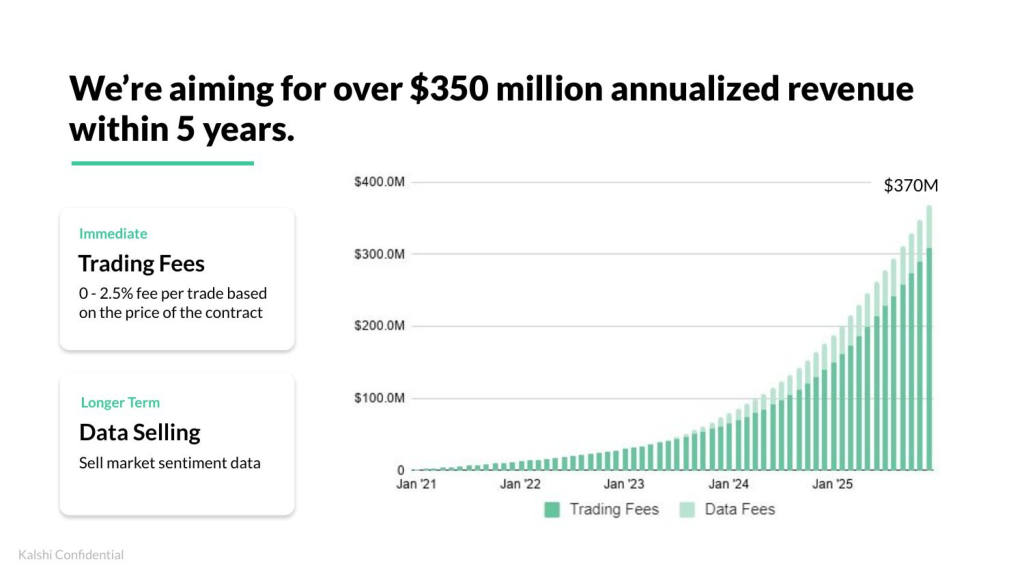
Slide 16 · Business model: $350M in annualized revenue
Trading fees of 0 to 2.5% per trade now and selling market sentiment data later, adding up to $370M in annualized revenue within 5 years.
How to write this slide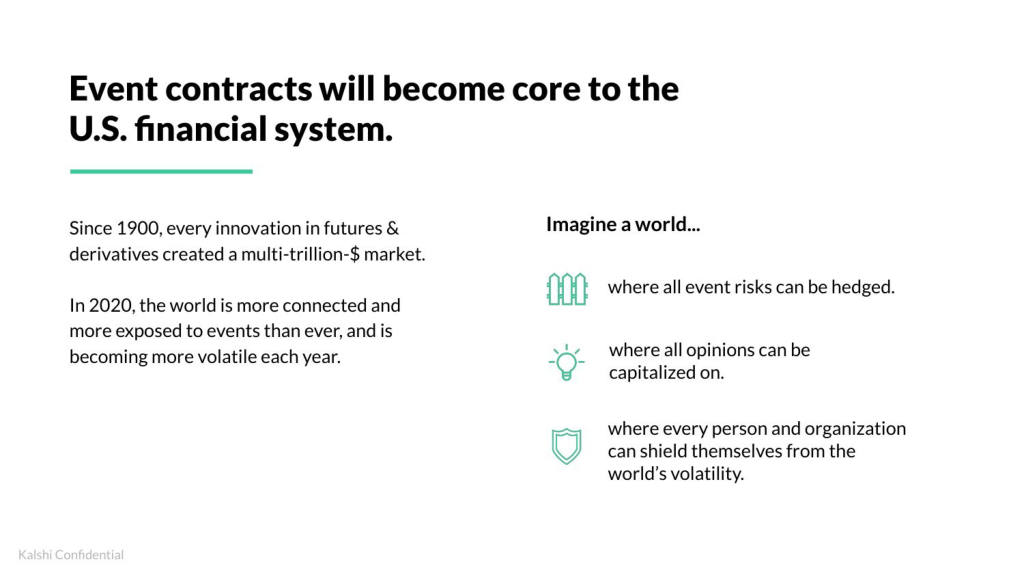
Slide 17 · Vision
Every innovation in futures and derivatives since 1900 created a multi-trillion-dollar market. Imagine a world where all event risks can be hedged and every opinion can be capitalized on.

Slide 18 · Q&A
A closing slide in Kalshi green.
What the Kalshi deck does well
- Slides 3 and 4 make a brand new idea feel like the obvious next step: grain futures, commodity futures and swaps each became a trillion-dollar market, and event contracts are placed as the next one on the same line.
- Slide 6 turns two years with no product into proof of progress, a dated list of every regulatory step, so the delay reads as a moat other teams would also have to cross.
- Slides 8 to 11 answer the question every marketplace investor asks, where the first liquidity comes from, with an affiliate market maker, a staged order of who to attract and a contract-farming loop.
- Slides 15 and 16 put a clear 5-year number on the hockey stick. Alfred Lin wrote that Kalshi did reach and beat those projections, even though the real curve was much choppier than planned.
What founders can learn from it
- If your moat is something slow and boring, like a licence, show it as a dated timeline. It explains why you have no revenue yet and why a copycat can't catch up fast.
- For a marketplace, spend slides on how you will get the first liquidity, not only on the size of the market. Kalshi gives it four slides.
- Ground a new category in history investors already know. One slide of precedent (grain futures to swaps) does more than a big TAM number on its own.
- You don't need polished headshots or a famous logo wall. Alfred Lin's own point is that Kalshi raised from Sequoia with a plain deck and a finance-intern-style photo.
Questions about the Kalshi pitch deck
- How much did Kalshi raise with this deck?
- Kalshi announced a $30M Series A on 17 February 2021, led by Sequoia Capital, with Charles Schwab and Henry Kravis also investing. This is the deck the founders used to pitch Sequoia.
- How many slides are in the Kalshi pitch deck?
- The Kalshi Series A pitch deck has 18 slides, ending with a Q&A slide.
- Is the Kalshi pitch deck real?
- Yes. Sequoia partner Alfred Lin published it on X on 1 November 2026, writing that Tarek Mansour and Luana Lopes Lara let Sequoia share the entire deck they used to pitch the firm. Some team panels are blacked out in that version.
- Did Kalshi hit the projections in its deck?
- According to Alfred Lin, yes. The deck aimed for over $5B in monthly volume and over $350M in annualized revenue within 5 years, and Lin wrote that Kalshi reached and exceeded that projection, although the path was much choppier than the chart, and Tarek Mansour has said it felt like nothing was working for five years.
Get your deck reviewed the same way.
Comments on every slide, the words to change highlighted, and the 3 fixes that matter.
More pitch decks
- AirbnbAirbnb pitch deck2008 · Seed · $600K
- UberUber pitch deck2008 · Seed
- CoinbaseCoinbase pitch deck2012 · Seed · $600K
- NotionNotion pitch deck2013 · Seed